Advancing Lexicographic Excellence, Building Bridges between China and Korea—Professor Wang Dan’s Learner’s Dictionary of Korean Adjectives Published Simultaneously in China and Korea
Recently, Learner’s Dictionary of Korean Adjectives, under the editorship of Professor Wang Dan of the School of Foreign Languages of Peking University, was officially published by The Commercial Press. Meticulously compiled over more than a decade, this dictionary is the first comprehensive learner’s dictionary in the world dedicated specifically to Korean adjectives. It fills several gaps in academic research and represents another landmark achievement in the development of dictionaries for less commonly taught languages in China.
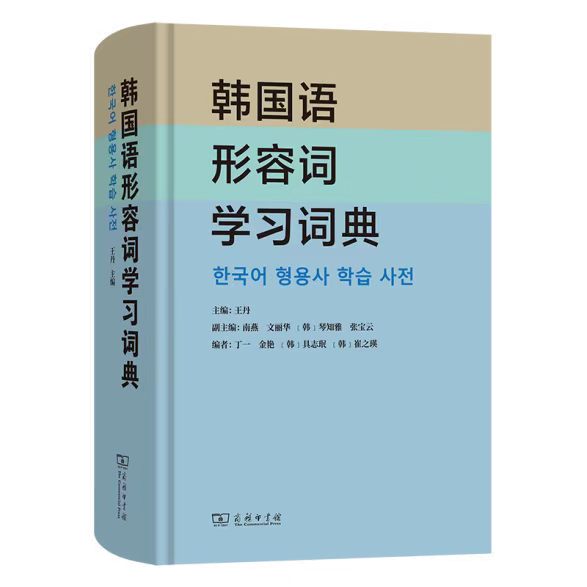
The cover of Learner’s Dictionary of Korean Adjectives
Origins: From a Doctoral Dissertation to a Published Monograph
The academic foundation of this dictionary can be traced back to Professor Wang Dan’s in-depth research during her doctoral studies at Seoul National University in South Korea. At the time, she keenly observed that although Korean adjectives are rich in emotional expression and vivid in their descriptive functions, they are characterized by complex morphological changes, diverse sentence patterns, and ambiguous meanings, and often has no direct equivalents in Chinese. These features constitute precisely the core obstacles Chinese learners encounter in understanding Korean adjectives.
Taking this as the starting point, Professor Wang Dan completed her outstanding doctoral dissertation, A Study on the Interpretation and Teaching of Korean Adjectives for Chinese Learners. Building on this research, she continued to explore the subject and published the Korean-language monograph A Study on Korean Adjective Education in South Korea in 2007. The monograph creatively integrates theories of Korean morphology, semantics, and syntax with theories of second-language acquisition, lexical function theory, object type theory, and contextual definition methods, thereby constructing a multidimensional interpretation model suited to the cognitive characteristics of Chinese learners. The book is held in the libraries of a number of renowned Korean universities, including Seoul National University and Yonsei University, and has been designated as a required reference work in Korean language education. Professor Kwon Jae-il, former director of the National Institute of Korean Language and a professor at Seoul National University, once described it as “one of the finest monographs in the field of Korean language education.” In 2011, Professor Wang Dan was awarded the Second Prize of the 11th “Outstanding Research Achievements in Humanities and Social Sciences of Peking University” for this book.
In-Depth Research: From Theoretical Exploration to Eight-Dimensional Interpretation
In 2009, the Ministry of Education Humanities and Social Sciences Research Project, “A Study on the Multidimensional Interpretation of Korean Adjectives for Chinese Students,” headed by Professor Wang Dan, was officially launched. Building on the team’s earlier theoretical research, the project team developed an eight-dimensional interpretation model and conducted a systematic multidimensional interpretation of 1,803 high-frequency core adjectives. The dictionary represents a systematic breakthrough from the traditional dictionary model: each entry comprehensively covers eight major modules—etymology and pronunciation, morphological inflection rules, core and extended meanings, applicable sentence patterns and usage restrictions, semantically related vocabulary in the semantic network, idioms and proverbs, Chinese equivalents, and corpus-based authentic example sentences. This multidimensional approach precisely addresses the difficulties Chinese learners encounter in understanding, distinguishing, and using Korean adjectives, and is of pioneering significance in the field of Korean language education research.
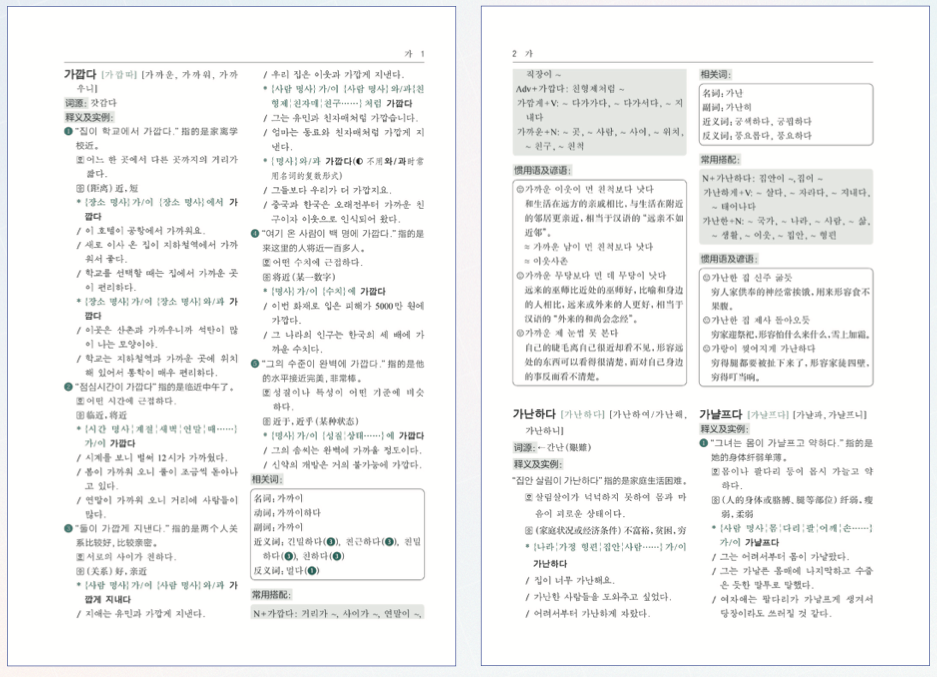
A page of Learner’s Dictionary of Korean Adjectives
Commitment: From Meticulous Compilation to Masterful Refinement
From the launch of the project in 2009 to its official publication in 2026, the compilation of this dictionary spanned more than a decade. After the Ministry of Education Humanities and Social Sciences Research Project was successfully completed, the team did not rush to publish the dictionary. Instead, they continued to refine and revise it, ensuring its scholarly value with rigorous academic spirit. From the compilation of the initial draft to the refinement of the finished volume, every entry underwent repeated deliberation and meticulous revision, embodying a commitment to excellence and rigorous refinement.
The editorial team brought together nine scholars from China and South Korea. Professor Wang Dan served as chief editor; Associate Professors Nan Yan, Wen Lihua, and Tenured Associate Professor Qin Zhiya served as deputy editors; Associate Professor Ding Yi served as an editor; and they jointly compiled the dictionary with alumni Zhang Baoyun and Jin Yan, as well as Korean scholars Gu Jimin and Choi Jiyoung. With more than 900 pages and 1.6 million Chinese characters, the substantial work represents the dedication and effort of every member of the team. Cross-national academic collaboration and extensive teaching experience have laid a solid foundation for the authority of this dictionary.
Looking Ahead: From Domestic Publication to Korean Edition
The new path of multidimensional interpretation pioneered by this dictionary can not only provide theoretical support for Korean language classroom instruction and contribute to the development of teaching materials and the optimization of instructional design, but also provide rich first-hand research materials for Korean linguistics and Chinese-Korean comparative linguistics.
As the first bilingual dictionary published since the launch of the “Archive Initiative” of the School of Foreign Languages of Peking University, this dictionary carries forward Peking University’s century-long tradition of lexicographic compilation in foreign language studies and demonstrates the profound academic strength of the Korean language program at the School of Foreign Languages.
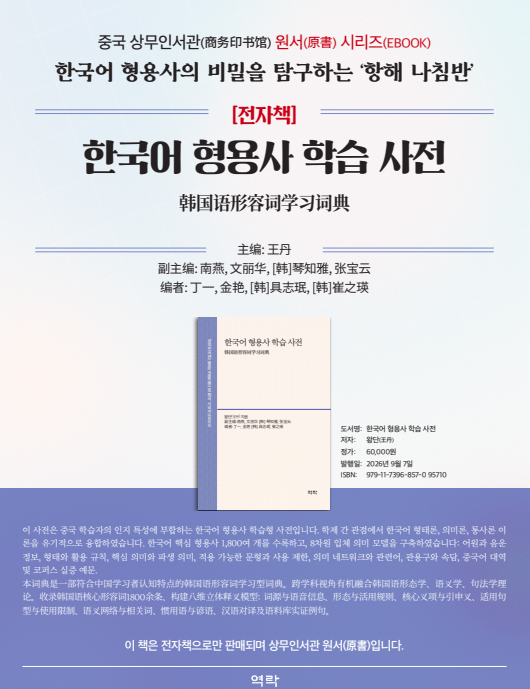
Promotional poster for the overseas release of the e-book edition of Learner’s Dictionary of Korean Adjectives
Notably, the dictionary has been acquired in its original edition by the Korean publisher Yeokrak (역락) and was officially released in Korea on September 1, 2026. The reverse export of this original Chinese achievement in Korean lexicography to Korea fully demonstrates its influence in the international Korean studies community. At the same time, it builds a solid bridge for two-way dialogue between the languages and cultures of China and South Korea, contributing Peking University’s intellectual insight and lexicographic expertise to the advancement of mutual learning and exchange among Chinese and foreign civilizations.
Written by: Department of Korean Language and Culture
Translated by: Qu Sizhe